
Beginnings
The brothers launched their business at an opportune moment. Cycling was booming. In 1923 bicycles accounted for 74 percent of all road traffic, with motor cars making up just 11 percent. For the average worker a bicycle was almost indispensable. Dutch bicycle production quadrupled over the decade. By 1925 almost all bicycles sold were made in the Netherlands and reflected the continuing demand for the familiar low cost, heavy black framed bicycle.
Production statistics from 1929 tallied 35 large manufacturers each with an average of 53 employees, and 58 firms overall making more than 500 bicycles a year. There were also over 200 smaller businesses, often repair shops assembling frames from imported parts packages. RIH was in the latter category, but with custom bicycle frame building being the priority and bike repairs squeezed in between.
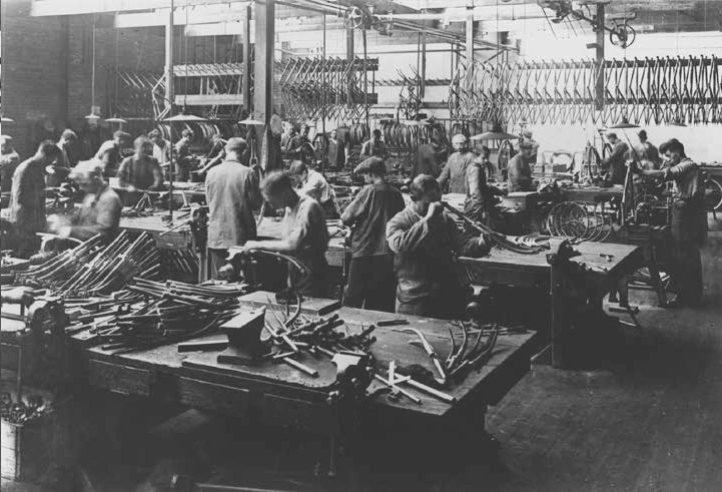
In their haste to boost production and keep the bikes affordable, mass fietsenmakers cut corners by eliminating costly details. Their bikes became utilitarian products assembled on factory lines using semi-skilled labor. In contrast, RIH bicycles stood out, being custom-fitted and carefully built by budding artisans.
Track racing specialty
The business officially opened its doors in 1921 in the Jordaan at 9 Eerste Boomdwarsstraat, doing repairs and building frames. Given their interest in bicycle competition, they concentrated on racing frames, although out of necessity they built any type of bicycle. Starting and running the business required much: the expense of specialized tooling, the cost of materials, rent, consumables, salesmanship, and the trial-and-error effort of perfecting frame design and build techniques. It wasn’t merely assembling and brazing tubes. They were also budding metalsmiths learning the art of precisely hand-filing roughly pressed steel lugs into attractive and strong fittings.
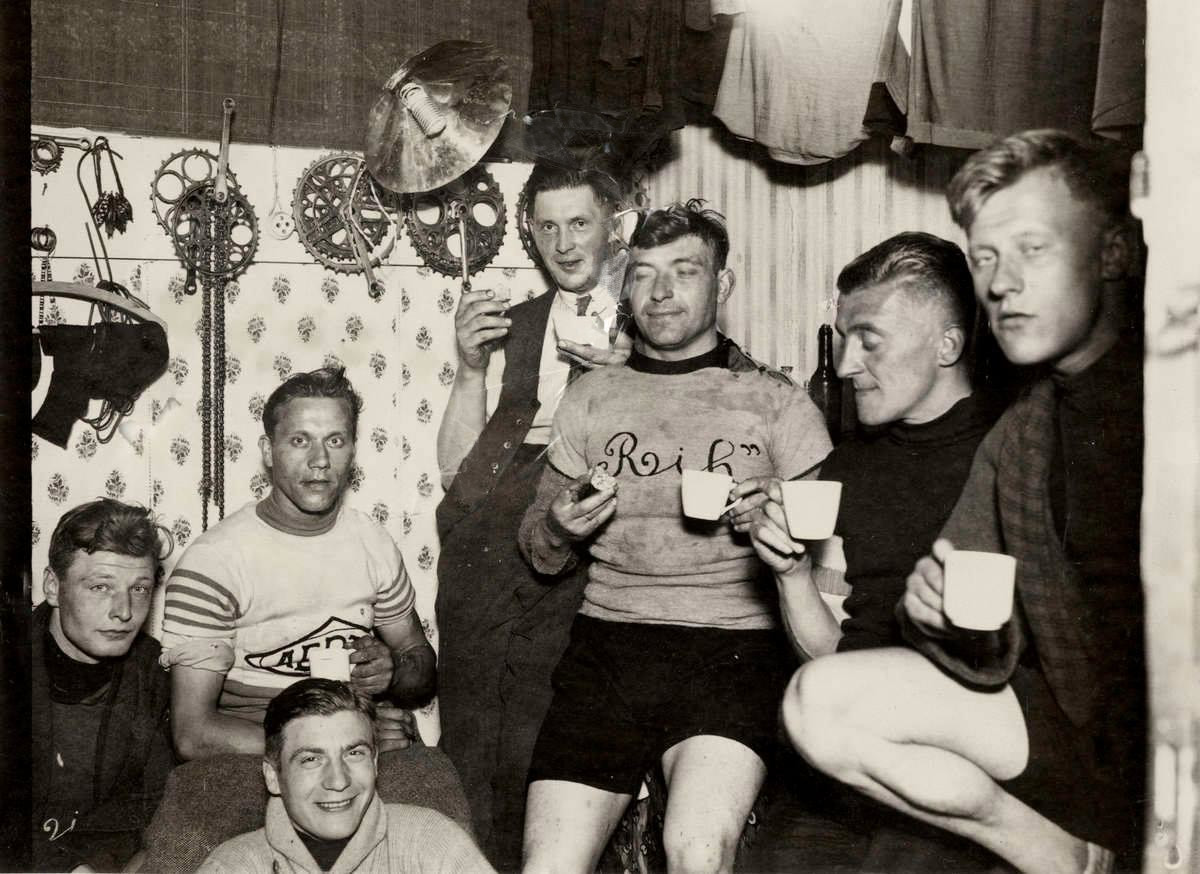
RIH quickly gained attention in the cycling community when Jan Hijzelendoorn, Sr clinched the Dutch amateur track championship on a RIH bike in 1924. As word spread, demand grew, and the promising business found itself cramped for space. Their advertising often listed additional locations, Westerstraat 93 and Commelinstraat 58, to accommodate their expanding operations.
Eventually the original shop’s capacity was recognized as inadequate leading to a relocation just a few blocks west to a more spacious building at Westerstraat 150. A presumably authoritative RIH 80th anniversary publication dates this move to 1928, although advertisements continued to mention the Eerste Boomdwarsstraat address until early 1937. The new Westerstraat location offered a street-level retail area and an upstairs workshop where RIH bicycles were meticulously handcrafted for the next eighty years.
From early on track cycling was popular in the Netherlands. The middle class, valuing order and morality, viewed open road racing as chaotic, unpredictable, and therefore obviously of immoral character. Self-control, balance, and consistency were traditional Dutch virtues worthy of protection.
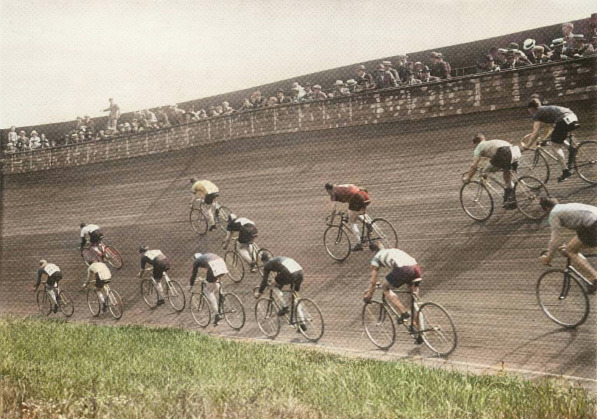
This led to a national ban on public road bicycle racing (Motor- en Rijwielwet) in 1905, making track racing the only alternative. At a time when long-distance races such as the Tour de France were becoming popular, the law had long-lasting consequences for Dutch bicycle racing.
Joop’s active racing involvement contributed to RIH’s growing familiarity with track bikes. In 1929 Joop returned to the shop to assist Wim, but the lure of the race track soon beckoned once more. This time Joop took on the role of a full-time pacer.
As a well-connected sprinter-turned-pacer, Joop’s network within the cycling community provided RIH with invaluable marketing exposure. He knew all the riders. And the crowd saw a motorcycle emblazoned with a bold red RIH logo racing around the track, reinforcing the brand’s prominence in track cycling.
Premium bicycles
Business was harder during the long Depression years. Frame building orders became scarce. Joop supplemented his income with motor pacing. RIH advertising focused on practicality, highlighting their “extra low prices and first class material…everything is custom built.” They sold touring and track frames as well as luxe tandems.
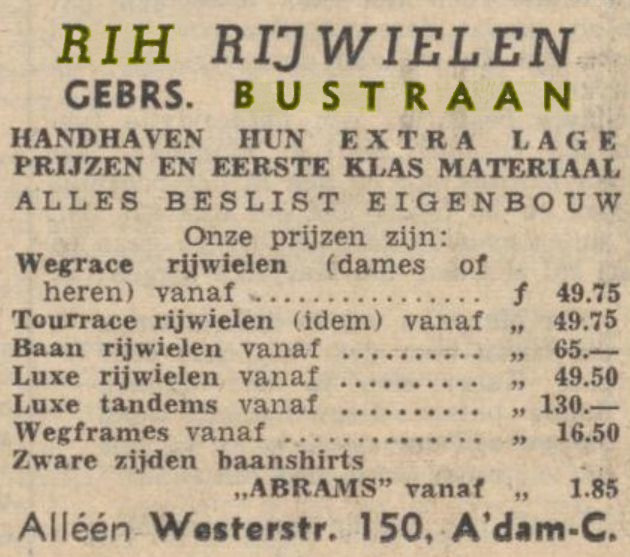
Extra lage prijzen? Not really. A 1937 advertisement offered their wegrace rijwielen (road racing bicycles) for 49.75 guilders. The typical Dutch bicycle sold for about half that price: 28 guilders. Their baan rijwielen (track bicycles) were even costlier at 65 guilders.
On the other hand, they were not selling a “typical Dutch bicycle.” By this time they were known for building lightweight, high-performance frames tailored to the exact needs of individual professional cyclists (“eerste klas materiaal…alles beslist eigenbouw”). A niche market, but a very small one. RIH faced a considerable headwind selling many premium bicycles during the protracted economic crisis.